1 Kings 8:10–30. Temple and Solomon
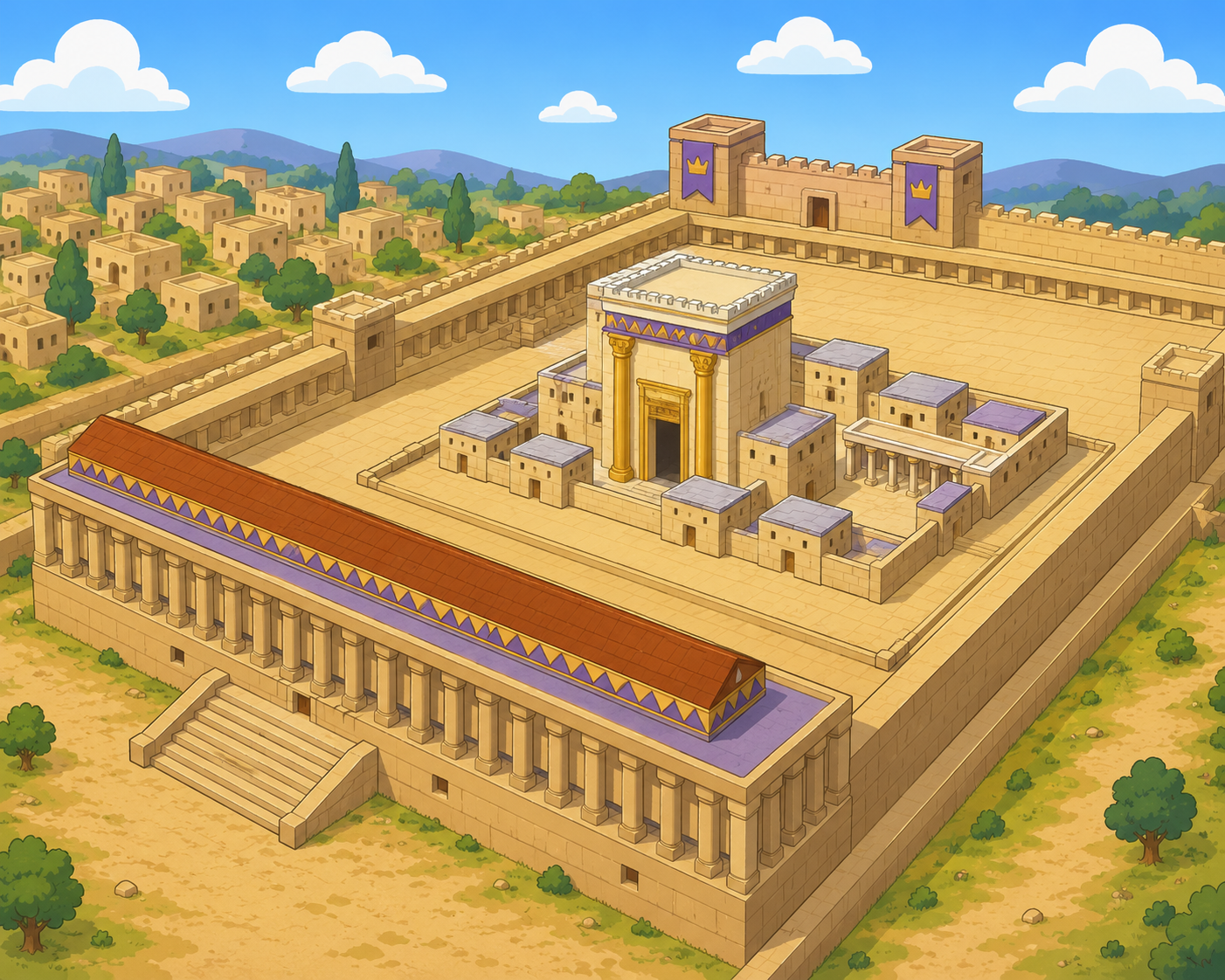
Temple
In the Bible, God often dwells with his people. He dwelled with Adam and Eve in the Garden of Eden. He appeared to people like Abraham, Isaac and Jacob. Then, during the days of Moses, he gave Israel the tabernacle, a special tent where God made his presence known among his people. The tabernacle was important, but it still had to be packed up whenever Israel moved and set up again wherever they stopped. As God’s people faced danger, suffering and uncertainty, how could they know that God would remain with them?
It’s an important question for us too. There will be times in life when it feels as though God has left you. Something will go badly wrong and you’ll wonder, What on earth is happening here? Is God still with me? So how do we know that God will stay with us and won’t ditch us? And what difference should that make to our lives? To answer those questions, we’re going to follow the Bible’s temple story through three stages: Temple + Solomon, Temple + Jesus and Temple + Us.
1. Temple + Solomon
God dwells with his people in the temple.
During the reign of King David, David wanted to build a house for God. By “house,” David meant a temple, a permanent building to replace the tabernacle. But God flipped the idea around. David wanted to build a house for God, but God promised to build a house for David. By “house,” God meant a dynasty, a family line of kings. God promised that one of David’s sons would build the temple and that David’s throne would endure forever (2 Samuel 7:11–13).
David therefore gathered materials and made preparations, but his son Solomon was the one who built the temple. This was a massive national project. Solomon conscripted 30,000 workers from Israel, alongside 70,000 carriers, 80,000 stonecutters and 3,300 foremen supervising the work (1 Kings 5:13–16). The temple itself was about 27 metres long, nine metres wide and thirteen-and-a-half metres high (1 Kings 6:2). It was built from carefully prepared stone, lined with expensive cedar, decorated with carvings of flowers, palm trees and cherubim, and covered with enormous amounts of gold. Even the construction was remarkable. The stones were shaped at the quarry, so “no hammer, chisel or any other iron tool was heard at the temple site while it was being built” (1 Kings 6:7). This wasn’t an ordinary construction project. A holy place was being prepared for God.
After seven years, the temple was finally finished. In 1 Kings 8, the Ark of the Covenant was carried into the Most Holy Place. The ark was the gold-covered chest connected with God’s covenant with Israel. Inside it were the stone tablets Moses had received from God.
Then came the really important bit: “And the priests could not perform their service because of the cloud, for the glory of the LORD filled his temple” (1 Kings 8:11).
Where was God? Right there. God’s glory filled the temple so powerfully that the priests couldn’t continue their work. It was too intense. God had come to dwell among his people.
Solomon responded, “I have indeed built a magnificent temple for you, a place for you to dwell forever” (1 Kings 8:13). That was the great advantage of the temple. A tent gets packed up, carried away and set up somewhere else. A temple stays put. Compared with the tabernacle, this looked like a far more permanent home for God among his people.
Solomon then praised God for keeping his promises: “LORD, the God of Israel, there is no God like you in heaven above or on earth below—you who keep your covenant of love” (1 Kings 8:23). God had made a promise to David, and now he had kept it. Solomon was on the throne. The temple had been built. God was dwelling with his people.
But Solomon also understood that even this magnificent building could never contain God. He prayed, “But will God really dwell on earth? The heavens, even the highest heaven, cannot contain you. How much less this temple I have built!” (1 Kings 8:27). Yes, God had chosen to dwell in the temple, but God wasn’t trapped inside it. The God who made the universe could never be squeezed into one building.
The temple couldn’t contain God’s presence, and a day would come when it wouldn’t, either. In 586 BC, the Babylonians captured Jerusalem and burned it to the ground. Wasn’t this where God lived? Yes, it was. If God dwelled with his people in the temple, what happened when the temple was destroyed? The temple was real, important and glorious, but it was never going to be God’s final dwelling place. That leaves us wondering: if the temple wasn’t God’s permanent home, where God would “dwell forever” among his people, what was?
2. Temple + Jesus
God dwells with us in King Jesus, the new temple.
The Jewish people eventually rebuilt the temple. Centuries later, King Herod began a massive reconstruction project. By the time of Jesus, work on it had already continued for forty-six years. Then Jesus arrived at the temple and made an extraordinary claim: “Destroy this temple, and I will raise it again in three days” (John 2:19).
The people were bamboozled. It had taken forty-six years to build this temple. How on earth could Jesus possibly rebuild it in three days? But Jesus wasn’t talking about the building. As John explains, “the temple he had spoken of was his body” (John 2:21). Jesus was saying that he was the new temple. He was now the place where God dwelled with his people.
That makes sense because Jesus isn’t merely someone who knows God or occasionally receives messages from him. Jesus is God the Son, who came to live among us. John writes, “The Word became flesh and made his dwelling among us” (John 1:14). God’s presence was no longer centred on a building. God had come to us in a person.
When Jesus said, “Destroy this temple,” he was speaking about his death. His enemies would kill him on the cross. But three days later, Jesus would rise again. Solomon’s temple was destroyed and had to be rebuilt by someone else. Jesus was killed, but he raised the temple of his body from the dead. This is good news. Unlike Solomon’s temple, Jesus will never be destroyed again. He is God’s true and permanent temple.
But forty days after rising from the dead, Jesus returned to his Father in heaven (Acts 1:3, 9). If Jesus is the new temple and Jesus has gone to heaven, how does God dwell with his people now? That brings us to the third stage of the temple story.
3. Temple + Us
Honour God with your body, the temple of the Spirit.
After returning to heaven, Jesus sent the Holy Spirit to dwell within his people. Paul tells Christians, “Do you not know that your bodies are temples of the Holy Spirit, who is in you, whom you have received from God?” (1 Corinthians 6:19). In the Old Testament, God dwelled among his people in the physical temple. Then God came to dwell with us in Jesus, the true temple. Now Jesus has returned to heaven and sent his Spirit to live within us. Christians are now God’s temple.
And the Spirit isn’t a temporary visitor. Paul says that Christians were “marked in him with a seal, the promised Holy Spirit,” who is “a deposit guaranteeing our inheritance” (Ephesians 1:13–14). God hasn’t merely visited us. He has placed his own Spirit within us as his guarantee that he will bring us home. His presence doesn’t depend upon a tent that can be packed up or a building that can be burned down. God’s Spirit lives within everyone who belongs to Jesus.
This doesn’t mean that we will always feel God’s presence. There will still be times when God seems distant and our circumstances make us wonder whether he has left us. But God’s presence doesn’t depend on our feelings or on whether life is going well. He has united us to Jesus, placed his Spirit within us and promised, “Never will I leave you; never will I forsake you” (Hebrews 13:5). When God feels absent, we can trust what he has promised. He may seem silent at times, but he’s not absent.
And one day, we won’t need to ask whether God is still with us. In the new creation, God’s dwelling place will be among his people forever: “Look! God’s dwelling place is now among the people, and he will dwell with them” (Revelation 21:3). There won’t even be a temple building because “the Lord God Almighty and the Lamb are its temple” (Revelation 21:22). What began in Eden will finally be complete. God will dwell with his people forever, and nothing will ever separate us from him again.
But if our bodies are temples of the Holy Spirit now, what we do with them really matters. Paul gives us a negative command and a positive command.
Negatively: flee from sexual immorality
Paul says, “Flee from sexual immorality” (1 Corinthians 6:18). The phrase “sexual immorality” translates the Greek word porneia. It refers broadly to sexual behaviour outside God’s design for marriage and comes from the same Greek word-family as our word “pornography.”
Paul doesn’t tell us to hang around sexual temptation and see how well we can resist it. He says to run away. For many young people, pornography is one of the most common forms of sexual temptation. It might also involve sexual messages, photos or pressure to cross boundaries with someone else. Paul’s command is clear: flee from it. This can be really hard, but think about what Paul is saying. If your body is a temple, it’s a place where God’s Spirit dwells. How could we deliberately use that same body for sexual immorality?
Positively: honour God with your body
But Christianity isn’t only about what we run away from. Paul also gives us a positive command: “Therefore honour God with your bodies” (1 Corinthians 6:20). This means far more than simply using our hands and feet to do helpful things. Paul’s point is that our bodies belong entirely to Jesus. They are members of Christ, temples of the Holy Spirit and bodies that God will one day raise from the dead.
That means you can’t separate what you do with your body from your relationship with God. Your sexual choices matter to him. Honouring God with your body means refusing to treat sex, pornography or another person’s body as something to use for your own pleasure. More broadly, it means refusing to treat your own body as worthless or disposable. This doesn’t mean making an idol of health, hitting the gym fourteen times a week, cutting all sugar from your diet or pretending that your body will never get sick or injured. It means caring for your body as something entrusted to you by God.
Why should we live this way? Not because our bodies are dirty or because sex is bad. It’s because our bodies belong to Jesus. He bought us at the cost of his own blood, his Spirit has made his home within us, and one day God will raise our bodies to everlasting life. Paul’s command is therefore both demanding and dignifying: honour God with your body.
God is With Us
God dwelled among his people in Solomon’s temple. Then he came to dwell among us in Jesus. Now he lives within us by his Spirit. And one day, God will dwell with us forever in the new creation.
So how do we know that God won’t leave us? We don’t judge his presence by our feelings or circumstances. We look to Jesus, in whom God came to dwell with us. We look to the Spirit, whom God placed within us as the guarantee of our inheritance. And we look forward to the new creation, when God will dwell with us forever.
You are God’s temple. God is with you, even when it doesn’t feel like it. So flee what dishonours him and use the body he has given you to honour him.
Discussion Questions
Pray and Get Going
Q1. When you hear the word “temple”, what comes to mind?
God’s dwelling place is a big deal in the Bible. In the Garden of Eden, God dwells with his people, but because of sin they’re removed from his immediate presence. In Exodus, God gives Israel the tabernacle, a temporary tent where he dwells among them. Then in 2 Samuel 7, King David wants to build God a more permanent house, a temple, but God says David’s son will build it instead. And that’s exactly what Solomon has done. In the previous chapters of 1 Kings, Solomon has built the temple. It took seven years to build, and it was filled with gold, cedar, bronze, and careful craftsmanship. Now, at the start of 1 Kings 8, the ark of the covenant is brought into the temple. This is the gold-covered box containing the tablets of the Ten Commandments. That’s where we pick up the story.
Look at 1 Kings 8:10–30
Q2. In verses 10-11, what happens when the priests withdraw from the Holy Place (one of the main rooms in the temple)?
Q3. According to verses 12–13, why does Solomon build the temple?
Q4. What things do we learn about God from Solomon’s prayer of praise? (see verses 15, 20, 23–24, 27)
Q5. Does the temple last forever, as Solomon says? (see 1 Kings 25:8–9 and John 2:19–22)
Look at 1 Corinthians 6:18–20
Q6. In what temple does God now dwell?
Q7. What does this mean for how Christians treat their bodies?
(Note: The Greek word translated “sexual immorality” is porneia (from which we get the word “pornography”). In the New Testament, it refers broadly to sexual activity outside God’s design for marriage between one man and one woman. It can include sexual sin with others, as well as sexual sin by oneself.)
Pray and Give Thanks