1 Kings 12:1–24. Division and Rehoboam
Division
At the moment, the Robinson household is slightly obsessed with maps. We’ve been studying the countries of the world, and one thing my kids keep noticing is that many of the world’s newest countries exist because an older country split apart.
Work backwards through recent history. In 2011, South Sudan separated from Sudan and became the world’s newest internationally recognised country. In 2006, Montenegro separated from Serbia and Montenegro. In 2002, East Timor, now known as Timor-Leste, became independent after years of Indonesian occupation. In the early 1990s, Yugoslavia broke apart, with Slovenia, Croatia, North Macedonia, and Bosnia and Herzegovina becoming independent countries. Go back further and there used to be two Germanys, East Germany and West Germany, formed in 1949 and reunited in 1990. North and South Korea were established as rival states in 1948 and remain divided today. Again and again, borders have been redrawn as countries that were once united have split apart.
Of course, we don’t only see division on maps. We see it in our own lives. Relationships break down. Friendship groups split in half at lunchtime because people can’t get along. Sometimes sporting clubs divide and a new rival club is formed because the parents, coaches or players have fallen out. Sometimes families divide. Sometimes even churches split because people can’t work through their differences. Division is everywhere.
Why is there so much division? And what hope is there for unity?
We’re faced with the division question in 1 Kings 12, where the kingdom of Israel is torn in two during the days of King Rehoboam. As we trace the story through to Jesus, we’ll begin to see what hope there is beyond division.
1. Division + Rehoboam
Pride divides.
Before we get to Rehoboam, we need a little context. In 1 Kings 11, Solomon married foreign wives and followed their gods. “He did evil in the eyes of the LORD; he did not follow the LORD completely, as David his father had done” (1 Kings 11:6). As a result, “the LORD became angry with Solomon because his heart had turned away from the LORD” (v. 9).
God therefore told Solomon that he would tear the kingdom away from him. However, he wouldn’t do it during Solomon’s lifetime “for the sake of David your father” (v. 12). Nor would he tear the entire kingdom away from David’s family. For David’s sake, and for the sake of Jerusalem, one tribe would remain under the rule of David’s descendants (vv. 12–13). But if it wasn’t going to happen during Solomon’s lifetime, when would it happen? The answer comes in chapter 12.
After Solomon’s death, his son Rehoboam travelled to Shechem, where the Israelites had gathered to make him king. Another man named Jeroboam had fled to Egypt to escape Solomon. When the Israelites gathered at Shechem, they sent for Jeroboam, and he returned with the whole assembly to make a request of Rehoboam: “Your father put a heavy yoke on us, but now lighten the harsh labour and the heavy yoke he put on us, and we will serve you” (1 Kings 12:4).
Rehoboam asked for three days to consider their request. First, he consulted the elders who had served his father Solomon. They gave him excellent advice: “If today you will be a servant to these people and serve them and give them a favourable answer, they will always be your servants” (v. 7). They told Rehoboam that the best way to lead his people was to serve them.
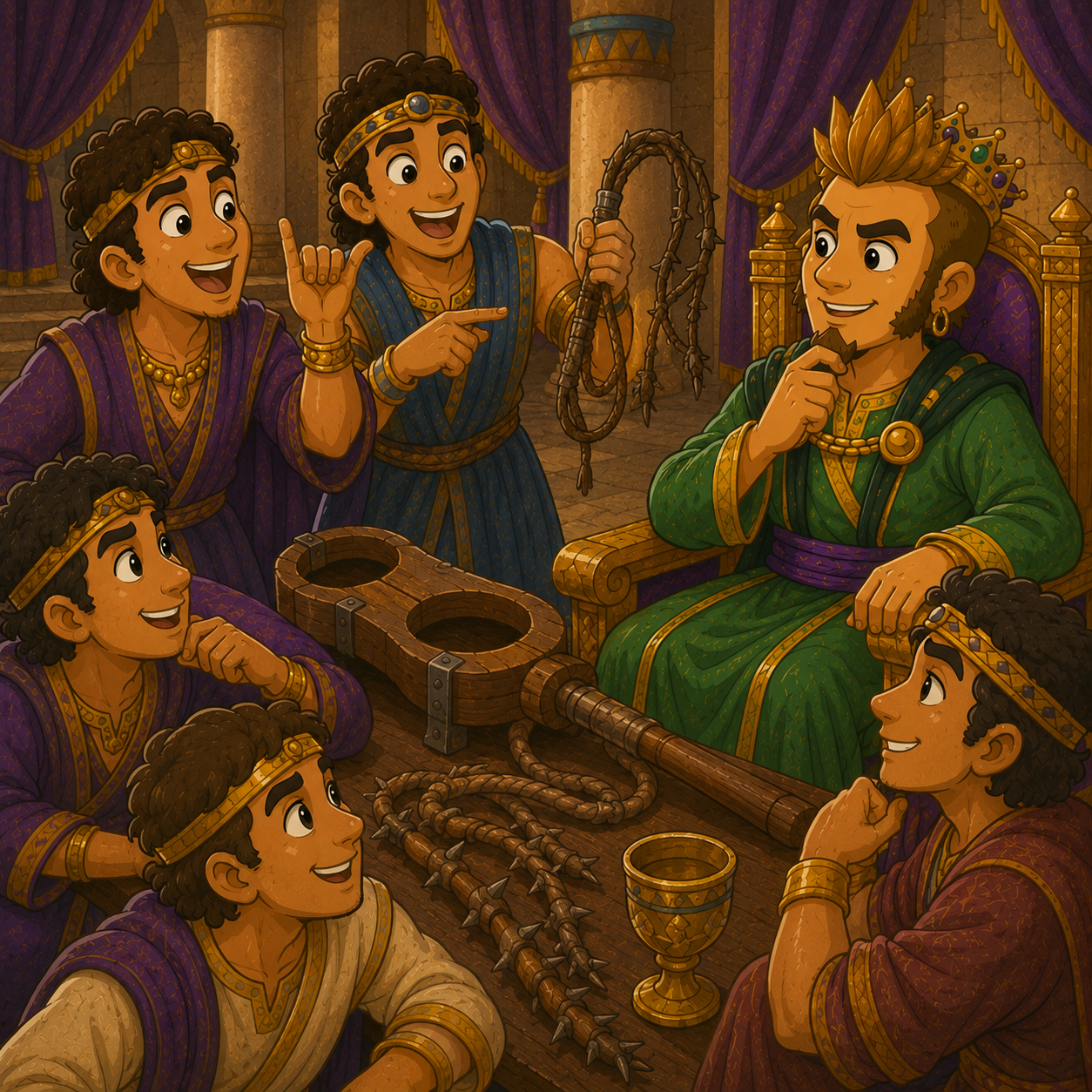
But Rehoboam rejected their advice and consulted the younger men who had grown up with him. They told him what he wanted to hear. They encouraged him to show everyone that he was stronger and tougher than his father: “My little finger is thicker than my father’s waist. My father laid on you a heavy yoke; I will make it even heavier. My father scourged you with whips; I will scourge you with scorpions” (vv. 10–11).
Three days later, Jeroboam and the people returned. We might expect Rehoboam to listen to the elders. Their advice was wiser, kinder and far more likely to hold the kingdom together. But Rehoboam was proud. He rejected the elders’ advice and followed the advice of his friends.
When Israel heard Rehoboam’s answer, the people revolted. They declared, “What share do we have in David, what part in Jesse’s son? To your tents, Israel!” (v. 16). Rehoboam then sent Adoniram, the official in charge of forced labour, to confront them. The Israelites stoned him to death, and Rehoboam barely escaped to Jerusalem. “So Israel has been in rebellion against the house of David to this day” (v. 19).
When the northern tribes heard that Jeroboam had returned, they made him their king. Rehoboam was left with the southern kingdom, dominated by Judah, with Benjamin remaining alongside it because of its close connection to Jerusalem and the house of David. Now there were two kingdoms. The northern kingdom continued to be called Israel, while the southern kingdom became known as Judah.
The southern kingdom’s capital was Jerusalem. The northern kingdom’s capital moved several times, but it would eventually settle in Samaria after King Omri built the city there (1 Kings 16:24). By the time of the New Testament, the people known as the Samaritans had historical and ancestral links to this old northern kingdom.
Rehoboam assembled 180,000 fighting men from Judah and Benjamin and prepared to take the northern kingdom back by force. But God sent him a message through the prophet Shemaiah:
“This is what the LORD says: Do not go up to fight against your brothers, the Israelites. Go home, every one of you, for this is my doing” (1 Kings 12:24).
Now there were two countries where there had once been one. Why did this division happen? At the deepest level, it was God’s judgement on Solomon’s idolatry. God had already announced that he would tear the kingdom apart. But the immediate human cause was Rehoboam’s pride. He refused to serve his people, rejected wise advice and listened to people who made him feel powerful.
Rehoboam’s story is a particularly dramatic example of a pattern we see everywhere. Division grows when proud people insist on getting their own way, refuse to listen and treat others as obstacles rather than people to serve. Behind so much of the division in our families, friendship groups, churches and nations is the same sinful pride we see in Rehoboam.
The result was one of the great geopolitical catastrophes of the Old Testament. God’s nation had been torn into two rival kingdoms.
Pride divides.
But division wouldn’t have the final word. Centuries later, after both kingdoms had fallen, God gave the prophet Ezekiel a picture of what he would one day do. Ezekiel was told to take two sticks, one representing Judah and the other representing Joseph and the northern tribes, and join them together. God explained:
I will make them one nation in the land, on the mountains of Israel. There will be one king over all of them and they will never again be two nations or be divided into two kingdoms.
Ezekiel 37:22
God promised to reunite his divided people under one king. Ezekiel goes on to identify this king as “my servant David” (v. 24). He wasn’t saying that the original David would simply return. He was looking forward to a new king from David’s family who would gather God’s scattered people and bring them together again.
Other prophets held out the same hope. Hosea said that Judah and Israel would “come together” under “one leader,” while Jeremiah promised that the two kingdoms would one day be reunited (Hosea 1:11; Jeremiah 3:18). The kingdom had been divided, but God promised that a new Davidic king would bring his people back together.
Who is that king? That brings us to Jesus.
2. Division + Us
Christ unites.
When we get to John 4, we begin to glimpse the kind of reunification promised by the prophets. Jesus is speaking with a Samaritan woman beside a well. This is already unusual. Jews and Samaritans had been divided for centuries and generally avoided one another.
The woman raises one of the great disputes between their peoples. Where should God’s people worship? The Samaritans worshipped on Mount Gerizim, while the Jews worshipped at the temple in Jerusalem. She says to Jesus, “Our ancestors worshipped on this mountain, but you Jews claim that the place where we must worship is in Jerusalem” (John 4:20).
Jesus replies that a new time is coming:
A time is coming when you will worship the Father neither on this mountain nor in Jerusalem.
John 4:21
Jesus isn’t saying that the differences between Jewish and Samaritan worship never mattered. He tells the woman that “salvation is from the Jews” (v. 22). God had revealed himself through Israel and promised that the rescuing king would come from David’s family. But now that king had arrived, worship would no longer be centred on Mount Gerizim or the temple in Jerusalem. “The true worshippers will worship the Father in the Spirit and in truth” (v. 23).
The woman knows that this has something to do with the promised Messiah. She says, “I know that Messiah is coming. When he comes, he will explain everything to us” (v. 25). Jesus responds, “I, the one speaking to you, I am he” (v. 26).
Jesus is the promised king who brings God’s divided people together. The old dispute about rival mountains no longer determines where people can meet with God. Access to the Father is now found through the Messiah. Jesus creates one people who worship the same Father, through the same Son, by the same Spirit.
This gives us a glimpse of what the prophets had promised. Ezekiel said that God’s people would no longer be divided into two kingdoms because one king would rule over them all (Ezekiel 37:22). Jesus is that king. Elsewhere, he describes his mission by saying, “There shall be one flock and one shepherd” (John 10:16). Clear Ezekiel vibes.
What begins beside the well continues after Jesus’s resurrection. In Acts 8, the gospel is preached in Samaria, Samaritans believe in Jesus and receive the Holy Spirit alongside Jewish believers (Acts 8:4–17). The old enemies are being gathered into one people under one king.
Jesus does bring division between those who accept him and those who reject him, sometimes even within families (Matthew 10:34–36). He doesn’t create unity by pretending that truth doesn’t matter. But everyone who comes to him is brought into one people.
Jesus brings Jews and Samaritans together. He brings Jews and Gentiles together. Most importantly, he unites sinful humanity to God. Rehoboam was a proud king whose leadership tore God’s people apart. Jesus is the humble king who gave himself to bring divided people together.
Christ unites.
3. Division + Us
We fight pride and chase unity in King Jesus.
How should we respond to this? We don’t want to be like Rehoboam, proudly ignoring wise advice and demanding that everyone else serve us. We live as people who have been united to Jesus, the king who brings unity. That means fighting the pride that divides people and pursuing the unity Jesus has created.
Paul writes:
Be completely humble and gentle; be patient, bearing with one another in love.
Ephesians 4:2
Rehoboam’s pride divided God’s people. Christians are called to take the opposite path. Instead of always trying to prove that we’re stronger, smarter or more important than other people, we pursue humility. Instead of responding harshly, we practise gentleness. Instead of giving up on people as soon as they become difficult, we remain patient and bear with them in love.
Paul then says:
Make every effort to keep the unity of the Spirit through the bond of peace.
Ephesians 4:3
Notice that Paul doesn’t tell us to create Christian unity. The Holy Spirit has already united us to Jesus and, therefore, to one another. Our responsibility is to protect that unity. We’re to “make every effort” because unity doesn’t happen automatically. Pride comes naturally. Patience, forgiveness and peace take work.
Paul explains why Christian unity matters:
There is one body and one Spirit, just as you were called to one hope when you were called; one Lord, one faith, one baptism; one God and Father of all.
Ephesians 4:4–6
Christians don’t merely share a building, a youth group or a few common interests. We belong to one body. We have received one Spirit. We trust in one Lord and share one hope. We have one God and Father. Our unity comes from God himself.
Fighting pride might mean shutting up long enough to listen to someone else. It might mean saying sorry without immediately explaining why the other person was also wrong. It might mean refusing to recruit half the friendship group to your side of an argument. Sometimes chasing unity means forgiving someone who has annoyed you, or asking a wise person for help before a disagreement becomes a disaster.
This doesn’t mean pretending that disagreements don’t matter or allowing serious wrongdoing to continue. Christian unity is unity in Jesus and his truth. But it does mean refusing to let pride, selfish ambition and personal grudges tear apart the people Jesus died to bring together.
Rehoboam’s pride divided God’s people. King Jesus brings divided people together. So, as people united to Jesus, we fight pride and chase unity.
Final Thoughts
Why is there so much division? Because sinful pride makes us insist on our own way, refuse to listen and treat other people as obstacles rather than people to serve. Rehoboam’s pride divided a kingdom, but the same pride continues to divide families, friendships, churches and nations.
What hope is there for unity? King Jesus. He is the promised king who brings divided people together, reconciles us to God and gives us one Spirit. Pursue unity eagerly.
And don’t follow Rehoboam down the pride path. Follow Jesus down the path of humility.
Fight pride and chase unity in King Jesus.
Discussion Questions
Pray and Get Going
Q1. Where do you see division (or divisions) between people?
Solomon started off as a pretty good king. But things began to go downhill when he married foreign wives and started worshipping their gods. It got so bad that God said Solomon’s kingdom would be split in two after his death (1 Kings 11:11–13). Solomon died around 931/930 BC, and Rehoboam his song became king. Solomon had built some brilliant buildings, including the temple and his palace, but by the time he died, many of the workers were completely pooped. One of those workers was a bloke named Jeroboam. And after Solomon died, Jeroboam and Rehoboam would end up at the centre of the kingdom splitting apart.
Look at 1 Kings 12:1–24
Q2. What do Jeroboam and the people ask for? How does Rehoboam respond?
Q3. What is the outcome for Israel (the northern tribes) and Judah (the southern tribe)?
Q4. Where is God in all of this? (See verses 15 and 24)
Centuries later, the prophet Ezekiel said God would one day reunite the divided kingdom. The northern kingdom and southern kingdom would become one people again under one king (Ezekiel 37:15–28). By Jesus’ day, the descendants of the southern kingdom were known as Jews. The Samaritans had links to the old northern kingdom and worshipped on Mount Gerizim, while the Jews worshipped in Jerusalem. That helps us understand John 4. When Jesus speaks with a Samaritan woman at the well, he isn’t just having a chat.
Look at John 4:21–26
Q5. How is Jesus kicking off a kind of “reunification” here?
Read this: We’ve just seen from John 4 that Jesus kicked off a reunification effort. Everyone who comes to Jesus is part of this unified people King Jesus has created.
Look at Ephesians 4:1–6
Q6. What is expected from King Jesus’ people according to this passage? How is this expectation different to what we see with King Rehoboam?
Q7. What kinds of things can we do to ensure that we pursue unity at church and youth?
Pray and Give Thanks