2 Kings 23. Reform + Josiah
Some reforms are small. You might reform your bedroom by moving the furniture around, throwing out some rubbish and finally putting away the clothes that have been sitting on the floor for three weeks.
Other reforms change countries, churches and the way millions of people think.
Reform is a big part of our history as Protestant Christians. During the Reformation, people such as Martin Luther and Thomas Cranmer called the church back to the authority of the Bible and to the good news that sinners are justified—declared right with God—through faith in Jesus, not by earning God’s favour.
Anglicans even had a young reforming king. Edward VI became king of England in 1547 when he was only nine years old. His father, Henry VIII, had separated the Church of England from Rome, but under Edward the church became much more clearly Protestant. Services were conducted in English, Cranmer produced a new Book of Common Prayer, and the church was brought back towards the authority of Scripture and justification by faith.
But Edward died when he was only fifteen. His Catholic half-sister Mary became queen, and many of his reforms were reversed. It's one thing to bring reform. It's another thing to bring reform that lasts.
More than two thousand years earlier, Judah had another young reforming king. His name was Josiah.
1. Reform + Josiah
Josiah became king of Judah in about 640 BC when he was only eight years old. By then, the kingdom was a mess. The northern kingdom of Israel had already been conquered by Assyria, while Judah had spent decades rejecting God under kings such as Manasseh and Amon. Pagan altars and idols had even been placed inside the LORD’s temple.
Reform begins with God’s Word
In the eighteenth year of Josiah’s reign—around 622 BC—he ordered that the neglected temple be repaired. While the builders were working, Hilkiah the high priest made an astonishing discovery:
“I have found the Book of the Law in the temple of the LORD.”
(2 Kings 22:8)
We aren’t told exactly where it was found. It may have been hidden away or simply forgotten during the reigns of Judah’s idolatrous kings. Hilkiah gave the book to Shaphan, the king’s secretary, who took it to Josiah and read it aloud.
When Josiah heard God’s Word, he tore his robes (22:11). Tearing your clothes was an ancient way of showing intense grief, horror or repentance. It wasn’t like smashing your phone because you’ve lost your temper. It was more like collapsing into a chair, putting your head in your hands and crying because you’ve suddenly realised how terrible something is.
God’s Word showed Josiah how badly Judah had sinned and how completely they had broken God’s covenant. The book hadn’t changed. God’s standards hadn’t changed. Judah had changed by moving further and further away from them. Josiah realised that things couldn’t stay the same.
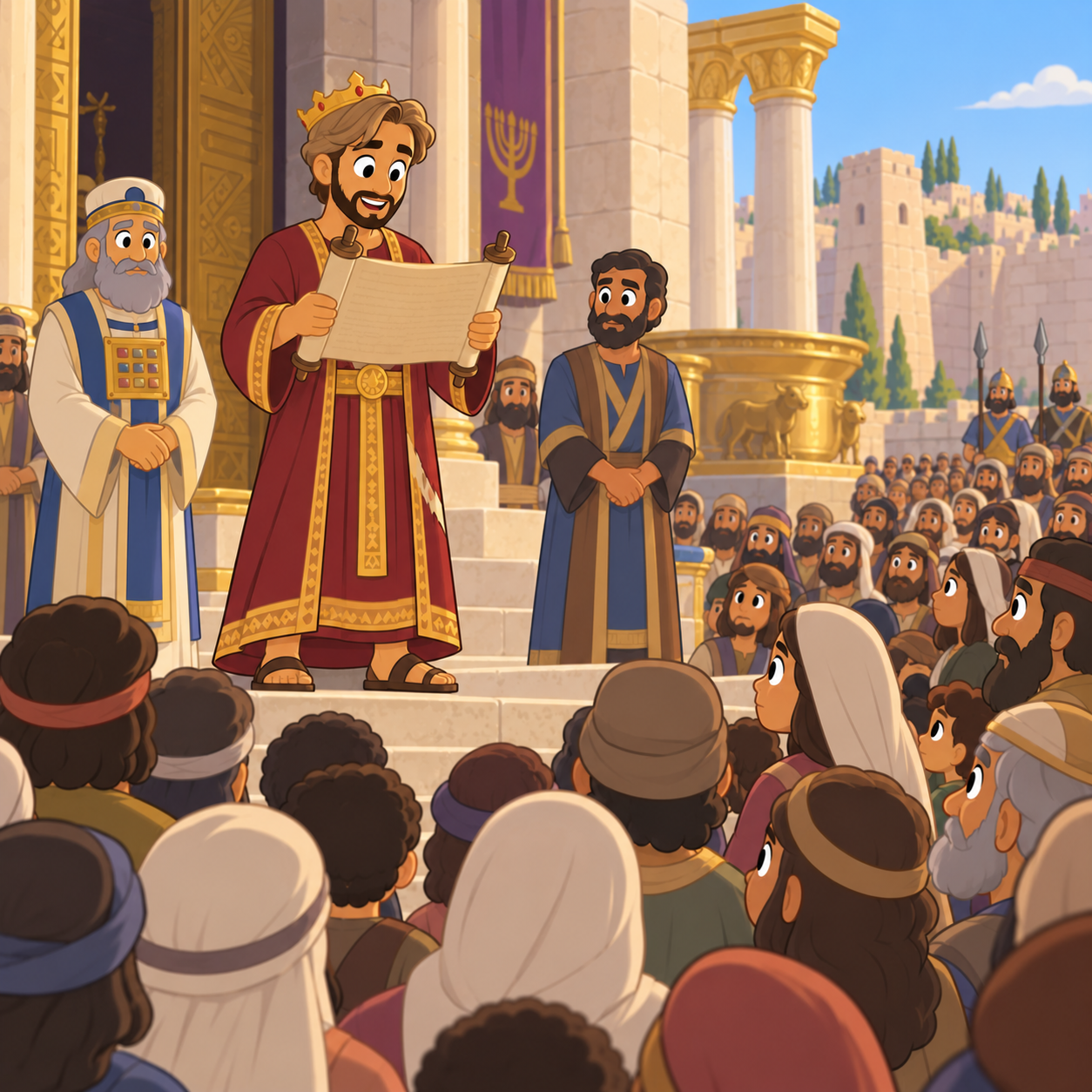
In 23:1–3, he gathered the elders, priests, prophets and people of Judah. Everyone came to the temple, “from the least to the greatest,” and Josiah read the Book of the Covenant aloud. God’s Word wasn’t kept for priests, scholars or important people. Everyone was brought under its authority.
Josiah then renewed Judah’s covenant with the LORD:
“The king stood by the pillar and renewed the covenant in the presence of the LORD—to follow the LORD and keep his commands, statutes and decrees with all his heart and all his soul.”
(2 Kings 23:3)
Before Josiah changed the temple or smashed an idol, he stood under God’s Word and committed himself to obey it. That is where real reform begins: when we stop asking God’s Word to agree with us and allow it to show us what needs to change.
For Josiah, that meant removing what was wrong and restoring what was right.
Reform means removing what is wrong
The geography of verses 4–20 helps us see how enormous Josiah’s reform was. It begins at the centre of Judah’s worship and keeps spreading outwards.
First, the temple. Objects made for Baal, Asherah and the “starry hosts” had been placed inside the LORD’s own earthly house. Baal was a Canaanite storm and fertility god. Asherah was a fertility goddess, often represented by a wooden pole. The “starry hosts” were the sun, moon, planets and stars. Judah had begun worshipping created things instead of the God who created them.
Josiah removed all of it. He carried the objects outside Jerusalem and burned them. He took the Asherah pole from the temple, burned it, ground it into powder and scattered the dust over graves. Nothing was left that could be repaired or returned. The idol was exposed as unclean and powerless.
Then, Jerusalem and Judah. Josiah destroyed the high places throughout the land. A “high place” was a local worship site, often equipped with an altar, sacred stone or Asherah pole. Some were used for false gods. Others may have been used to worship the LORD, but not in the way he had commanded. Deuteronomy 12:5–14 told Israel to bring its sacrifices to the place God chose rather than creating worship sites wherever they wanted.
Josiah also desecrated Topheth in the Valley of Ben Hinnom, where people had sacrificed their children to Molek. He removed horses and chariots dedicated to the sun and smashed pagan altars built by earlier kings. He even destroyed high places Solomon had built around three hundred years earlier for the gods worshipped by his foreign wives (1 Kings 11:5–8).
Some of these practices were ancient traditions. But Josiah didn’t preserve them simply because they were old or connected with famous kings. If God’s Word said they were wrong, they had to go.
Finally, Bethel and Samaria. Josiah travelled north into the territory of the old northern kingdom. When Israel split into two kingdoms, Jeroboam I had established rival worship centres at Bethel and Dan. He made golden calves, appointed his own priests and created his own religious festival because he feared losing his people’s loyalty if they continued worshipping in Jerusalem (1 Kings 12:26–33).
Around three hundred years before Josiah, an unnamed prophet had stood beside Bethel’s altar and announced:
“A son named Josiah will be born to the house of David.”
(1 Kings 13:2)
Now Josiah arrived at Bethel. He demolished the altar, crushed the high place and burned its Asherah pole. He then continued through Samaria and removed the other high places.
The altar at Bethel had stood for centuries, but God’s Word outlasted it. What God had spoken eventually happened. Josiah’s reform had moved from the temple, through Jerusalem and Judah, and into the old northern kingdom.
Reform means restoring what is right
But true reform isn’t only about destroying what is wrong. God’s Word also showed Josiah what needed to be restored.
In verses 21–24, Josiah brought back faithful worship of the LORD. He commanded the people:
“Celebrate the Passover to the LORD your God, as it is written in this Book of the Covenant.”
(2 Kings 23:21)
This doesn’t mean that no one had celebrated Passover since the time of the judges. Hezekiah had held a major Passover years earlier (2 Chronicles 30). The point is that Josiah’s Passover was unusually comprehensive and carefully shaped by God’s written Word.
Josiah had removed what was wrong and restored what was right. He had cleaned out the temple, destroyed the high places, removed false gods, stopped child sacrifice, demolished Bethel’s altar and brought back the Passover.
If any king could reform Judah, surely it was Josiah. Then we receive this extraordinary summary:
“Neither before nor after Josiah was there a king like him who turned to the LORD as he did—with all his heart and with all his soul and with all his strength, in accordance with all the Law of Moses.”
(2 Kings 23:25)
Josiah was the best king Judah had seen. But the next verse begins with one devastating word: “Nevertheless.”
Josiah’s reforms don’t last
“Nevertheless, the LORD did not turn away from the heat of his fierce anger, which burned against Judah because of all that Manasseh had done to arouse his anger.”
(2 Kings 23:26)
Josiah was the best king. He brought the biggest reforms. Nevertheless, even his reforms weren’t enough to remove Judah’s guilt or save the nation from judgment.
Then Josiah died. In about 609 BC, he confronted Pharaoh Neco of Egypt at Megiddo and was killed. His servants carried him back to Jerusalem and buried him. Just beyond our passage, Josiah’s son Jehoahaz becomes king and immediately returns Judah to its old direction:
“He did evil in the eyes of the LORD, just as his predecessors had done.”
(2 Kings 23:32)
Josiah had changed Judah’s worship and public life, but he hadn’t permanently changed the people’s hearts. Once he was gone, the kingdom returned to its old ways—much like many of Edward VI’s reforms were reversed after his death centuries later.
In response to God’s Word, Josiah brought reform, but it was temporary.
If Judah’s best king couldn’t remove their guilt, change their hearts or save them from judgment, they didn’t simply need another reforming king. They needed a King who could reform them from the inside.
2. Reform + Jesus
Josiah heard God’s Word and reformed the temple. Jesus is God’s Word made flesh. He comes to the temple as the true temple and brings reform that lasts.
At the beginning of John’s Gospel, we read:
“The Word became flesh and made his dwelling among us.”
(John 1:14)
God’s eternal Word had entered the world as a human being.
In John 2:13–22, Jesus went to the temple in Jerusalem and found people selling animals and exchanging money. Those services were connected with sacrifice and could be useful, but the temple had become a marketplace. The business of buying and selling was taking over the place where people were meant to come before God.
Like Josiah, Jesus acted with startling authority. He made a whip from cords, drove out the animals, scattered the coins and overturned the tables:
“Stop turning my Father’s house into a market!”
(John 2:16)
The religious leaders demanded a sign proving that Jesus had the authority to do this. Jesus answered:
“Destroy this temple, and I will raise it again in three days.”
(John 2:19)
They thought he meant the enormous stone building, which had been under construction for forty-six years. But John explains that “the temple he had spoken of was his body” (John 2:21).
Jesus wasn’t simply cleaning up the old temple system. He was announcing that the temple—and everything it represented—would be fulfilled in him. The temple represented God’s presence among his people and was where sacrifices were offered for sin. Now God had come to live among his people in Jesus. Jesus himself was the true temple.
Josiah brought reform, then died, and the kingdom returned to its old ways. Jesus brings lasting reform through his death and resurrection. At the cross, he bears the judgment sinners deserve. Then he rises, never to die again. His saving work can’t be undone or reversed.
Josiah could cleanse a building; Jesus cleanses sinners. Josiah could smash idols; Jesus can change idolatrous hearts. Josiah could restore the Passover; Jesus becomes our true Passover sacrifice, dying to rescue his people (1 Corinthians 5:7).
As God’s Word, Jesus brings reform that lasts.
Jesus has done what Josiah never could. But what does his lasting reform look like in the lives of the people he saves?
3. Reform + Us
Jesus’ saving work doesn’t need to be reformed. His death and resurrection achieved everything necessary to save us. We don’t reform ourselves to earn forgiveness or make God accept us. We come to Jesus because only he can cleanse us, forgive us and give us new life.
But the people Jesus saves are still being changed. One of the main ways Jesus changes us is through the written Word of God:
“All Scripture is God-breathed and is useful for teaching, rebuking, correcting and training in righteousness, so that the servant of God may be thoroughly equipped for every good work.”
(2 Timothy 3:16–17)
God’s Word showed Josiah what needed to be removed and what needed to be restored. It does something similar in us. Scripture teaches us what is true, rebukes us by exposing what is wrong, corrects us by showing us the right way and trains us to keep living God’s way. It doesn’t reform us simply so that we know more Bible facts. It equips us to live for Jesus at school, at home, online, at church, with our friends and when nobody else is watching.
So do we take God’s Word as seriously as Josiah did?
It's easy to agree with the parts of the Bible we already like, collect one helpful idea and then continue as before. Josiah heard God’s Word and realised that things couldn’t stay the same. His response was immediate, costly and enormous.
You don’t respond by literally smashing statues or burning chariots. You bring your sin to Jesus, trust the forgiveness he purchased at the cross and ask:
What does God’s Word say needs to be removed from my life?
What does God’s Word say needs to be restored or built into my life?
Perhaps God’s Word shows you something that needs to be removed: lying, cruel speech, hidden sin, inappropriate content or your hunger for other people’s approval. Bring it to Jesus. Take whatever concrete steps are needed to turn away from it.
Perhaps God’s Word shows you something that needs to be restored. Honesty with your parents, kindness towards someone you have hurt, regular prayer, or time in the Bible. Reform isn’t only about stopping what is wrong. It's also about returning to what God says is right.
Let God’s Word reform you.
Let it show you what needs to be removed and what needs to be restored. And when it shows you how far you fall short, don’t trust your own reforms to save you. Trust Jesus, the better King, who died and rose to make you new.
Discussion Questions
Pray and Get Going
1. If you were put in charge of reforming your school for one day, what would you change?
Look at 2 Kings 23:1–30
2. Look at verses 1–3. What does Josiah do after hearing God’s Word? What does this show us about where genuine reform begins?
3. Look at verses 4–20. What do you notice about Josiah's reforms? What does this tell us about how seriously Josiah takes God’s Word?
4. Josiah removes false worship in verses 4–20 and restores the Passover in verses 21–24. Why does genuine reform require both removing what is wrong and restoring what is right?
5. Compare verses 25 and 26. What is so remarkable about Josiah—and why are even the reforms of Judah’s best king unable to remove its guilt or save it from judgment?
Look at John 2:13–22
6. What similarities can you see between Josiah and Jesus?
7. According to verses 19–22, what can Jesus achieve through his death and resurrection that Josiah could never achieve?
Look at 2 Timothy 3:16–17
8. What does Scripture do in these verses? How do they help us work out what needs to be removed and what needed to be restored?
9. What might God’s Word be telling you to remove from your life? What might it be telling you to restore or build into your life?